Website development for agricultural companies
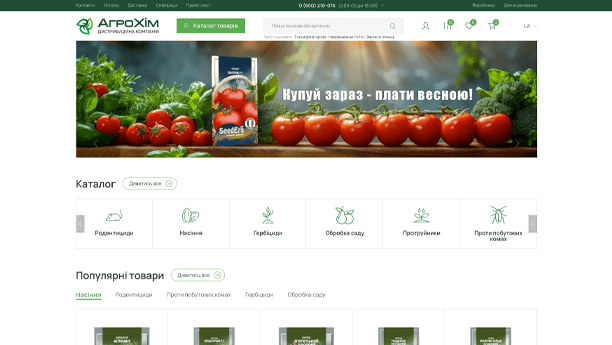
An agronomist does not search by brand name — they search by active ingredient, crop and pest. We build a catalogue that answers that in three clicks, on a site that survives the seasonal spike.
Who it is for
Crop protection and fertiliser suppliers
Hundreds of products, each with an active ingredient, application rate, target crops and a regulation. A PDF price list cannot carry that.
Farms, grain elevators, processing
The site works on counterparties and export: who you are, what volumes you handle, which documents you hold. Often it is the first thing an overseas buyer sees.
Seasonal demand
Enquiries peak over a few weeks. The site has to be ready before the season, not launch in the middle of fieldwork.
What is included
Search by active ingredient
The one thing that separates an agronomic catalogue from an ordinary one. Ingredient, concentration and formulation are separate fields you can search and filter on.
Selection by crop and pest
Buyers arrive from the problem side: "wheat, septoria". The catalogue leads from crop to pest to product, instead of demanding they already know the brand name.
Application regulations
Rates, growth stage, pre-harvest interval, number of applications — as a table on the product page. This is what brings people back a second time.
Documents in one click
Certificates, safety data sheets, registration documents, container labels. Files are named for humans, not "doc_final_2.pdf".
Where to buy
Dealers and offices as a list and on a map, with contacts and regions. If you sell through a network, the site has to hand the customer over to it.
Multilingual setup and technical SEO
Ukrainian, Russian and English with correct hreflang. Catalogue structure follows how agronomists search, not how the warehouse classifies stock.
Technologies
- PHP 8.3
- WordPress
- ACF Pro
- Polylang
- MySQL
- Elasticsearch
- JavaScript
- TypeScript
- REST API
- Docker
- catalogue import from Excel
FAQ
How is an agricultural site different from a normal corporate one?
The catalogue. Everything else — about, contacts, news — is standard. But a product page carrying an active ingredient, application regulations and documents needs its own field structure, and that is what the search traffic rests on.
Do we need a shopping cart?
Usually not. Crop protection products and fertilisers sell through managers and dealers, in bulk, under contract with deferred payment — a cart does not fit that. A catalogue with an enquiry form is enough. If you sell small packs at retail, we will discuss a store separately.
How do we maintain a catalogue of three hundred products?
Through an Excel import: columns with specs, regulations and documents map onto fields. Nobody maintains that volume by hand, and neither will you.
What about seasonality?
Launch before the season, not during it. Development takes 3–5 weeks plus time to populate the catalogue — we count the start date backwards from that.
Do we need an English version?
If you export or plan to, yes, and preferably from the start. A language can be added later, but migrating already-indexed URLs costs more than laying the structure down up front.
What does it cost?
From $2000. The catalogue drives the figure: how many products, how many attributes, whether crop-based selection is needed. We quote exactly after the brief.
Websites by industry
Pages showing our work in a specific industry, at the same prices and timelines.